baked egg rolls sparkling watermelon agua fresca maple balsamic vinaigrette my mom


copyright jennifer yu © 2004-2013 all rights reserved: no photos or content may be reproduced without prior written consent

archive for photography

rolling solo

Saturday, September 22nd, 2012

Dear readers, I’ve been thoroughly enjoying your comments on the giveaway post. You people are fascinating and hilarious and awesome and sweet! These interesting little tidbits you have shared with me (and the rest of the interwebs) have been a true joy to read while I’m on the road. My readers are THE BEST. Thanks for the smiles and laughs and all around fabulousness. If you haven’t entered yet, please do so! Lurkers, I’ve got your back!

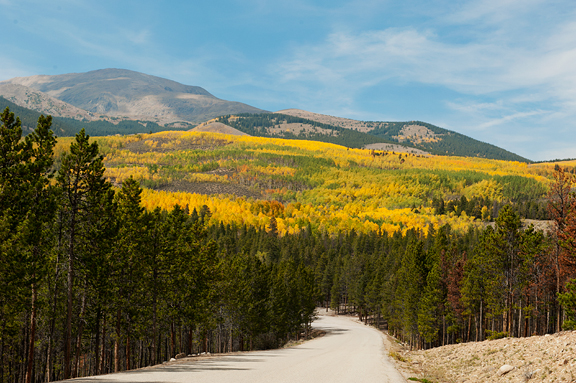
So I’m writing from the great Colorado mountain town of Crested Butte. It’s a former mining town, but today the gold in the hills comes in the form of aspens. This is my eighth season shooting the fall colors and it never gets old. In fact, it just gets better because I feel like I know these places, these hillsides, these trees. It’s just me, the road, and Colorado.


and construction


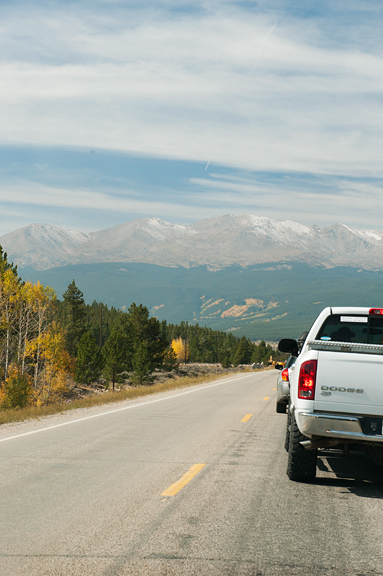
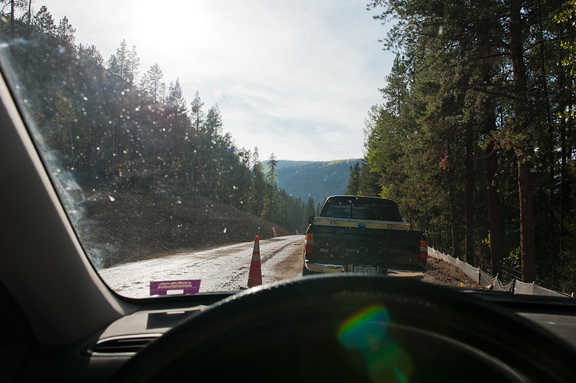
There is a lot of construction going on in that last minute rush to beat the winter storms that are sure to arrive any day. This means a lot of waiting in your car with views of the mountains through the smoky haze of wildfires (from states to our west) and someone’s tailgate in your face.

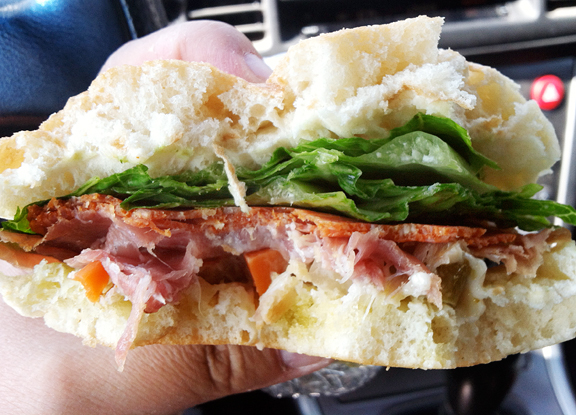
also a good time to eat the sandwich i packed (iphone)


But most of the drive west is lovely, dotted with brilliantly yellow trees along creeks (cottonwoods) and roadsides (some aspen). And then you drive along the flanks of the tallest mountain in the state and a lump develops in your throat because it is just incredible to behold.

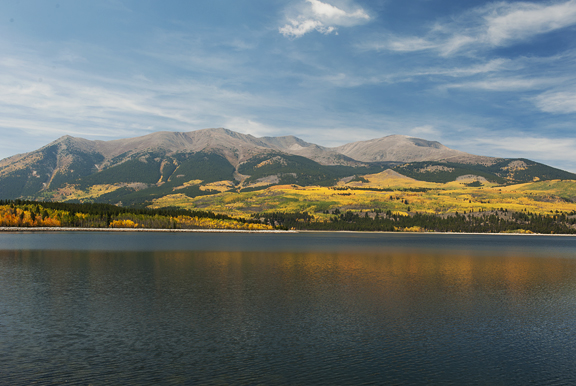
mount elbert and the forebay (iphone)

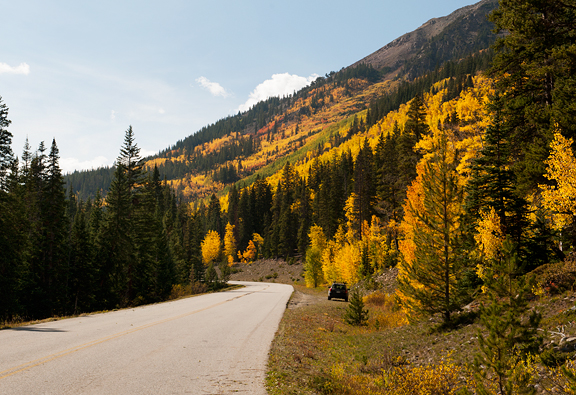
i never tire of roads like these


Traveling mid-week means a hefty reduction in the typical leaf-peeping traffic and I mostly had the roads to myself. But whenever and wherever I stopped, I almost always encountered other leaf enthusiasts. They were all there to relish the fall colors. These people were incredibly friendly and full of joy, with huge smiles on their faces. Some asked technical questions, others asked for local tips (where to go, what’s good to see), but everyone was super nice. One young couple pulled into an empty trailhead parking lot, jumped out of their car, threw their arms in the air and whooped and hollered. When they left they waved and I waved back. “Have an awesome day!” they shouted as they sped off. Colorado can do that to people.

me and my trusted subie, road trippin’

ah yes, more construction (this one cost me an hour)


Last year was the best display of colors I had seen since I started shooting fall colors here. And 2012… looks like it’s giving 2011 a run for its money. We are on the early side of peak, but peak colors are fast approaching and it’s all just unbelievably glorious. There are big swaths of green and yellow punctuated by a good showing of reds and oranges this year. Some patches are brown or spotted or dull, some patches are bare. It’s a complete mix.

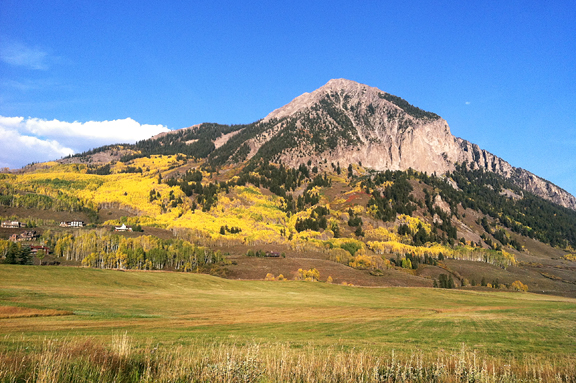
finally arrived to see mount crested butte in the last hour of daylight (iphone)


**Jump for more butter**

travel: maine, the great state (long)

Tuesday, September 4th, 2012

There is a special love I have for the state of Colorado – the place I call home. You can probably sense that from the way I photograph and write about Colorado in this space. It is not unlike the adoration that Mainers have for Maine. Before last week, Maine was never much on my radar except when good friends of mine waxed nostalgic for it (my pal in graduate school always referred to her as, “Maine, the great state”). But my western-centric attentions were pointed East when my friend, Sharon (who I met at IFBC Seattle in 2009 on a chance shared cab ride), invited me out on behalf of The Maine Office of Tourism and The Schooner J. & E. Riggin for a trip to explore some of their fine state. So yeah, I was in Maine last week and it was… AWESOME.


Full disclosure: The Maine Office of Tourism and The Schooner J. & E. Riggin sponsored my transportation, lodging, and meals with no obligation on my part. All photographs, words, experiences, and especially opinions, are my own.

Day 1: Portland: El Rayo Taqueria, Cantina El Rayo
Day 2: Portland: Gulf of Maine Research Institute, The Well, Jordan’s Farm, Broadturn Farm, Maine Mead Works, Regency Garden CafĂ©, Fore Street
Day 3: Portland to Rockland: Standard Baking Company, Rock Paper Scissors, The Slipway, Salt Water Farm, Rock City Roasters, J&E Riggin, In Good Company
Days 4-7: Rockland, Stonington, Camden: The Schooner J. & E. Riggin, Rheal Day Spa

Day 1: I left my house in the Colorado Rockies at 3:45 am and arrived at the Portland Regency Hotel and Spa in Portland, Maine, with enough time to drop off my bags and change my clothes for dinner. Joining my travel companions Joy and Rebecca, we walked with our host, Sharon, to the brightly colored and lively El Rayo Taqueria. The smell of savory Mexican food drifted on the fresh sea air as we approached. There we met with several local Portland food scene folks for refreshing margaritas and appetizers on the patio where every table was occupied with happy patrons.


a round of margaritas de la casa – perfection on a summer evening

flash fried shishito peppers with oaxacan sea salt, chips, salsa, and guacamole

abigail describes the different oysters she brought from her farm

and there were fabulous goat meat tacos… did i mention this was merely appetizers?!


El Rayo is run by the dynamic duo: executive chef Cheryl Lewis and general manager Norine Kotts. Their kitchen manager, Elena McMahan, gave us a tour of her urban garden which supplies the restaurant with fresh herbs and edible flowers in summer. The incredible oysters we sampled came from Abigail Carroll’s oyster farm: Nonesuch Oysters. I got to step inside the restaurant (which was also hopping) and get a quick tour from Cheryl.

pickled peppers at the counter

festive and packed with locals

the busy line keeps up with demand


We then walked next door to the swankier Cantina El Rayo which features cocktails and more refined fare compared to its sister, El Rayo Taqueria. I sat next to Margaret Hathaway and Karl Schatz of Ten Apple Farm, Elena, and Anestes Fotiades who writes Portland Food Map. Not only was everyone genuinely warm, but they are all fascinating people. Margaret and Karl supplied the goats for our dinner (from their farm). I think I kinda fell in love with those two. Here are just some of the noms we enjoyed for our meal, although I was in a food coma by the time the churros rolled around. Everything was fantastic. And then Cheryl gave us each a luscious, frosted coconut cupcake as a take-home treat.

the cantina

blueberry shrub refresco (yes to this!!)

delectable hibiscus pickled deviled eggs

heavenly chili pesto oysters

mexico city style street corn with cotija cheese and chipotle

goat meatballs with mole sauce and pickled onions

griddled hoja santa leaves with three cheese and tomatillo sauce


Things I really liked from Day 1
Virgin margarita and goat meat tacos at El Rayo Taqueria.
Oysters from Nonesuch Oysters.
Blueberry shrub refresco, chili pesto oysters, and Mexico City style street corn at Cantina El Rayo.
My elastic waistband pants.
A comfy bed at the Portland Regency Hotel and Spa.

Day 2: To counter the effects of the first night’s feast (hey, elastic only gets you so far), I got myself to the Regency’s fitness center for a run before our tour of the Gulf of Maine Research Institute (GMRI). Blaine Grimes explained how the institute provides a supportive connection between the science of the Gulf of Maine (and its watershed) and the communities that depend on it. GMRI builds working solutions to balance the needs of the environment with the needs of the fishing industry. Additionally, they have developed an impressive outreach program to educate Maine’s 5th to 8th graders on the Gulf of Maine through interactive exercises that teach the scientific method (this was the coolest thing ever).


gmri

blaine starts with an overview of the physical geography of the region

educating children by not giving the answers, but letting them discover for themselves


After the tour, we moseyed on over to Jordan’s Farm where Penny Jordan welcomed us. She then ushered us down to The Well, a tiny unassuming restaurant on the farm that is only open for dinner service. Chef/owner Jason Williams graciously hosted us for a special lunch demo of his preset menu. Much of the food is locally sourced, if not harvested right off the farm – fresh and beautifully prepared to highlight the ingredients. Jason’s kitchen is a converted trailer and there are outdoor tables and a couple of screened gazebos where patrons can enjoy an exquisite meal.

penny greets us in front of her farm stand

heading down to the well

nice fresh summery touches

jason works his magic here

in the gazebo

gorgeous salad with summer tomatoes and house-cured bacon

shishito peppers and a peekytoe crab sandwich

penny, jason, and his family joined us for lunch

vanilla bean maine blueberries with shortbread


**Jump for more butter**

add a little zing to your life

Sunday, August 12th, 2012

Technique: shooting lightning

You could say I have a slight obsession with lightning. Our house faces southwest and in the summer, the southwest monsoons move over us from that direction almost every afternoon like clockwork. I can see the thunderstorms in the distance as they approach, dropping lightning bolts on the Continental Divide and neighboring ridges. Familiar enough with the patterns, I’ve been able to capture some great strikes and more likely than not, miss plenty of other great strikes. When I share my photos, someone will invariably marvel at my presumed quick reflexes and my amazing ability to anticipate the lightning.


multiple cloud to ground strikes (10 seconds, f8, 29mm, ISO 100)


My reflexes are pretty quick, but they aren’t THAT quick. And my anticipation of lightning is as good as my observation that there is a lightning storm in progress. The trick is not to wait to take a snap when you see the lightning, because on average cloud-to-ground lightning discharges on the order of milliseconds. No one is that fast and luck only gets you so far. To achieve consistently decent results, I take the longest possible exposure and do so consecutively throughout a lightning storm.

If you plan to try shooting lightning, there are a few things I’d like to recommend:

1) You’re going to have to shoot on manual.

2) Use a tripod. You’ll need it for all of those long exposures.

3) Go with short focal lengths (wide angle). If you’re just starting out, give yourself a wide field of view to capture any random lightning strikes that may occur around you. Once you become familiar with the storms of a certain area (i.e. they always strike a certain ridge or an isolated microburst is hammering away in one area) then you can tighten the shot and use longer focal lengths.

4) Resolution helps. If you are choosing between your 18 mega-pixel camera and your 8 mega-pixel camera, go with the bigger sensor. The reason? You will most likely crop down to isolate the lightning if you are shooting a wide field. More pixels help to maintain a better image when you crop down.

5) Start with a fully juiced battery. Long exposures drain the battery faster than your typical snaps.

6) Make sure you have plenty of memory. Who knows how long this storm will last? Wouldn’t it suck if you ran out of memory on your flash card only to have the mother of all lightning bolts strike right after your card finished? Yes.

7) If possible, shoot from a sheltered area or safe distance. Thunderstorms are often accompanied by rain, so being able to shoot from the doorway of my deck helps to keep the rain off of my lens until the winds start driving the rain into the house. If you are far enough away from the storm to shoot it in the distance, great. However, keep in mind that being out under an approaching storm (even if it isn’t raining) puts you at an increased risk of getting zapped. If it IS raining and you are outside with an umbrella over your gear during an active thunderstorm, then you’re just asking for trouble (and by trouble, I mean death).

8) Don’t get killed. Lightning is no joking matter. Lightning can carry over a billion volts.

night lightning
Probably the easiest way to shoot lightning is during a nighttime lightning storm. I like to focus just shy of infinity because that’s usually where my local lightning hits, set my aperture to f8 or thereabouts, leave my ISO on 100 (or the lowest native ISO setting), and put the shutter speed on 6 seconds if the storm is active, and up to 20 seconds if the strikes are less frequent. I cannot actually see where I am focused because it’s pitch dark, but I know from daytime experience that this side of infinity works for me on a relatively wide angle (less than 45mm). Same thing goes for field of view. I usually have to futz with my camera and wait for a lightning strike to light up the area so I can frame my field of view. Again, as with most of my nighttime photography endeavors, I like having a red light headlamp so I can see my gear without blinding myself.

I live in a location with minimal light pollution, so dark is truly dark. If I were to take an exposure for 20 seconds at night, it would be mostly black. Now if lightning were to strike in my field of view anytime during that 20 seconds when my shutter was open, it would be captured in my image. If there were two lightning strikes a few seconds apart, but both within the 20 seconds when my shutter was open, I’d have two strikes captured in my image.


forked lightning (20 seconds, f8, 44mm, ISO 100)


Thunderstorms used to catch me off guard, but these days I watch for them. First, I check the weather report for that evening which is wrong a good 50% of the time. Then I check the radar to follow active storms moving our way. Of course, I can also tell when the storm is arriving from the flashes of light in the distance and the rumble of thunder nearing. It’s kind of exciting. As the storm moves over my location, things usually go downhill quickly. For one thing, the rain and winds make it almost impossible to continue shooting (I put the hood on the lens at night, which helps at the start of the rain, but is useless when driving rain is coming right at you). Secondly, when the storm is directly overhead, not only does the rain prevent me from shooting straight up, but I’d have to be outside, under a massive electric potential (that is dangerous).

cloud to cloud (16 seconds, f2.8, 20mm, ISO 100)


Night lightning in dark places is pretty straightforward because you can set your shutter speed to whatever you like. When conditions are lighter, like sunset or dusk, or if there is considerable light pollution coming from city lights, traffic, or even the moon, then I try to take care that my shutter speed doesn’t blow out the other light sources. This means there will be a limit on the shutter speed to achieve proper exposure of the entire image. It makes for a nice composition if you can get those elements in place in addition to the lightning.

storm at sunset (15 seconds, f7.1, 26mm, ISO 100)

evening strike (10 seconds, f22, 20mm, ISO 100)


**Jump for more butter**